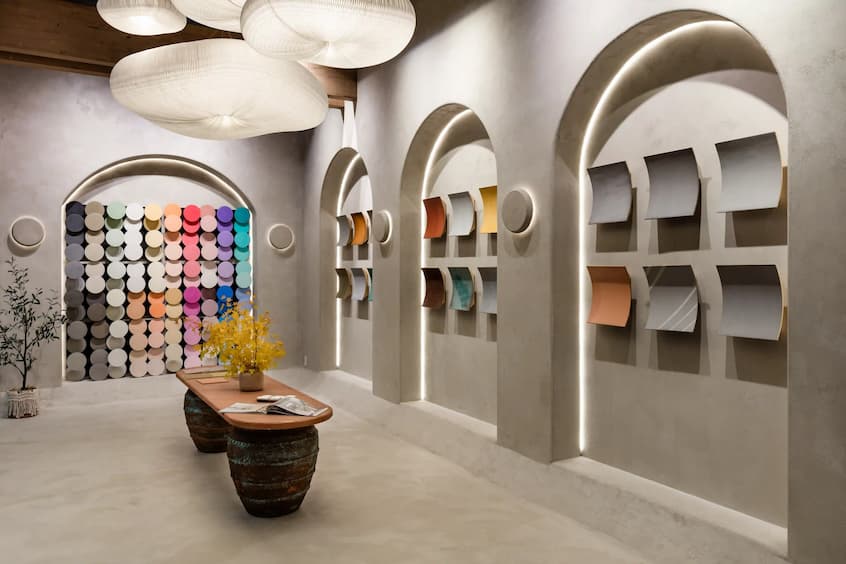
Is microcement eco-friendly? Compared with most floor or wall renewal options, it is often the lower-impact choice. Most of the benefit comes from what it avoids: tearing out the old surface, hauling debris away, and bringing high-emission products into your home. It still contains cement, so the full answer depends on the mix and how long the finish lasts.
Craftex is the exclusive US distributor of Cement Design microcement and trains the certified installers who apply it.
Key Takeaways
- Microcement can go over sound existing tile and concrete, so the old surface does not have to become demolition waste.
- Cement Design's data sheets list our Eco-Cement products as solvent-free, and the Baseflex base coat contains selected recycled aggregates.
- The microcement we distribute holds EC-1 Plus certification, the strictest emissions class in the GEV EMICODE scheme.
- Cement remains the binder, so microcement is lower-impact, though not impact-free.
- A microcement surface stays eco-friendly only if it never needs redoing, and that comes down to preparation and installer training.
Is Microcement Eco-Friendly Compared With Other Finishes?
For a renovation, it usually beats tearing out and replacing the old surface, because it works with what is already there. Microcement goes on in layers totaling 2 to 3 mm and bonds to sound tile, concrete, plasterboard, and other stable substrates. Your bathroom or kitchen gets a new surface, and you never have to break up the old one.
That avoided waste adds up. The US EPA estimates that the country generated 600 million tons of construction and demolition debris in 2018, more than twice its municipal solid waste. Demolition produced more than 90% of that debris.
Keeping sound tile in place as the base keeps that part of your renovation out of those numbers. It also means no dumpster on the driveway and no demolition dust in the rest of the house. Our guide to applying microcement over existing tile explains when you can leave the old surface in place.
Here is how microcement compares with tile and polished concrete on demolition, waste, and emissions. Our microcement vs. tile guide also compares the two on cost and durability.
What Is in the Eco-Cement Collection?
At Craftex, Eco-Cement is the name of our core microcement collection. Cement Design's data sheets describe each texture as an eco-cement-based coating and list the products as solvent-free. Baseflex, the leveling base under the finish coats, is described as an eco-cement made from mineral fillers and selected recycled aggregates.
The collection comes in four textures graded by grain size and foot traffic, with ultrafine Classic at one end and coarse Rustic, made for garages and commercial floors, at the other. You can compare them on our Eco-Cement finishes page.
Beyond our own range, eco-friendly cement is a broad label, and products sold under it vary widely. Before you choose any, ask what is in the mix and which claims an independent lab has tested.
Does Eco-Friendly Cement Still Have a Carbon Footprint?
Yes. Cement and concrete production account for roughly 5% to 8% of global CO2 emissions, according to a July 2026 summary from Columbia Business School’s Climate Knowledge Initiative. About 85% of cement emissions come from making clinker, which means heating limestone in a kiln until it releases CO2.
Using less clinker in the mix is one way producers cut those emissions, according to the same summary, and using less cement overall is another. Microcement uses cement as well, so it does not escape that footprint. What changes is the amount: a 2 to 3 mm coating applied over an existing surface, instead of a new substrate that must be made and installed first.
Is Microcement Safe for Indoor Air?
The microcement products we distribute carry EC-1 Plus certification from GEV EMICODE, the scheme’s strictest emissions class. To earn a license, a product must pass testing by an independent laboratory under a standardized procedure, and inspection institutes later buy licensed products off the market, choose them at random, and test them again. Our data sheets page lists the certificate for each product.
That matters inside a home. The US EPA reports that levels of several organic compounds average 2 to 5 times higher indoors than outdoors, and paints and varnishes are among the usual sources because they contain organic solvents.
EC-1 Plus sets the tightest limits in the scheme. In GEV's chamber test, total VOC emissions from a flooring installation product must fall to 60 micrograms per cubic meter (µg/m³) or less after 28 days, compared with 100 for EC1 and 300 for EC2. All three classes also cap formaldehyde and carcinogenic substances.
For architects and designers, that gives a third-party emissions class to cite in a specification instead of a general low-VOC claim. For homeowners, it matters most in bedrooms and other rooms that stay closed for hours, and in the first weeks after installation, which is why the test measures emissions at 3 and 28 days.
Does Microcement Support Green-Building Goals?
It can support several common renovation goals, as long as each contribution is described accurately:
- Less demolition, because the system goes over sound tile or concrete instead of replacing it.
- Reuse of the existing substrate, which stays in place as the base.
- Low-emission documentation, since the Cement Design products we distribute carry EC-1 Plus certification.
- Less new material, with a 2 to 3 mm system instead of a new substrate and finish.
LEED certifies buildings, not products, so no microcement is LEED-certified. A product can only supply documentation, such as emissions certificates, that a project team submits toward a credit, and the project's LEED consultant decides whether it qualifies.
Why Do Architects and Designers Specify Microcement for Renovations?
Renovation specs often come down to what the existing building allows. Microcement works within those limits:
- A 2 to 3 mm build-up keeps finished floor levels close to the original.
- One continuous surface without grout lines can run across floors, walls, and bathrooms.
- Application over sound existing surfaces cuts demolition, dumpsters, and dust, which means less disruption in occupied homes and commercial spaces.
- Technical data sheets and EMICODE certificates are available for the specification package.
- Only certified installers can buy and apply the system, so the crew on site has been trained on it.

What Mistakes Cancel Out the Environmental Benefits?
Whether microcement is eco-friendly in your home depends on how long the surface lasts. A floor that cracks or wears through early gets stripped and redone, which adds a second round of material and waste.
Architects, designers, contractors, and homeowners can order Eco-Cement samples, review our technical data sheets, or contact our team for specification support and a system recommendation for your project. Send your room size and a few photos of the existing surface, and we will tell you whether it can stay in place as the base for your new finish.
Read next: Microcement vs. Tile: Which Is Actually the Better Investment?
Frequently Asked Questions
Is microcement more eco-friendly than tile?
It depends on your starting point. Over sound existing tile, microcement avoids demolition and the debris it creates. In a new build, tile has a longer track record, and InterNACHI estimates floor tile life expectancy at 75 to 100 years.
Is microcement low VOC?
Yes. The Cement Design products we distribute hold EC-1 Plus certification under GEV EMICODE, the scheme's lowest-emission class, and their data sheets list them as solvent-free. To earn that class, total VOC emissions must fall to 60 µg/m³ or less after 28 days in GEV's test.
Does microcement contain cement?
Yes. Cement Design's data sheets describe each Eco-Cement texture as an eco-cement-based coating, applied over the cement-based Baseflex leveling base. That is why microcement has a carbon footprint, although a 2 to 3 mm system uses much less material than a new substrate. Our guide to what microcement is covers the basics.
Is microcement sustainable?
It can be the more sustainable choice in a renovation, mainly because it avoids demolition and reuses the existing surface. It is not impact-free, since it contains cement. How long the surface lasts, and so how often it needs redoing, depends on the system, installation quality, traffic, maintenance, and periodic resealing.
Can microcement go over existing flooring?
Over sound, well-bonded tile and concrete, yes, and that is where most of the environmental benefit comes from. Wood subfloors need a cement board layer first, and hollow or loose tile has to be fixed or removed. Our microcement flooring page covers floor applications.
Can microcement contribute to LEED projects?
LEED certifies buildings, not products, so microcement itself cannot be LEED-certified. A project team may be able to submit its documentation, such as emissions certificates, toward a credit. Ask us for the data sheets and EMICODE certificates, and your LEED consultant can confirm whether they meet the credit requirements.
Is microcement safe for indoor residential use?
Yes, once it is installed and sealed. The products we distribute hold EC-1 Plus certification for low emissions, and countertops get a food-safe sealer. During installation, follow your installer's advice on ventilation, and keep the room clear until the surface is ready for use, about 48 hours afterward.
What is the difference between Eco-Cement and Metallic microcement?
Eco-Cement is our main collection, in four textures. The Metallic collection is separate, with five metal finishes: iron, brass, bronze, aluminum, and copper. Our two-day installer course covers it alongside Eco-Cement. Our data sheets list GEV EMICODE certificates for both collections.
Can I see Eco-Cement in person before deciding?
Yes. Book a visit to the Craftex showroom in Seattle, or order an Eco-Cement color sample: $50 for a 12-by-12-inch panel or $75 for a 24-by-24-inch panel. Check it under your own lighting, since the shade shifts with changing light.
How soon can I use the room after installation?
Installation takes 3 to 14 days, depending on project size, substrate condition, the number of layers, and the system installed. The surface is generally ready for use about 48 hours after installation and reaches full cure around 28 days.
Sources
- Columbia Business School Climate Knowledge Initiative, Decarbonizing Cement, July 2026.
- US EPA, Sustainable Management of Construction and Demolition Materials, updated March 2026.
- US EPA, Volatile Organic Compounds’ Impact on Indoor Air Quality, updated June 2026.
- GEV, EMICODE Limit Values and GEV in Brief, August 2026.
- InterNACHI, Standard Estimated Life Expectancy Chart for Homes.
- Cement Design, Eco-Cement and Baseflex technical data sheets, August 2016.
- Tile Council of North America, bulletin on ceramic tile, VOCs, and healthy homes.
- This Old House, polished concrete flooring guide, updated April 2026.
- Bob Vila, How to Seal Grout, updated June 2024.